
Research
Produce evidence on the governance, architecture and application of DPI.




An initiative of NEES/UFAL
Launching on NEES.dados · 2026
Research, development, experimentation and training to connect technologies, institutions and people around the public interest.
From Brazil to a global agenda

01 · About the lab
The DPI Lab — Digital Public Infrastructure Lab is an initiative of NEES, at the Federal University of Alagoas.
The lab brings together researchers, students and national and international partners to investigate how shared digital infrastructures can support governments and public-interest services. Our agenda combines scientific rigor, experimentation and cooperation, with attention to the context of each territory.
NEES/UFAL
NEES's experience, serving this agenda
Social technologies, applied research and work alongside education policy give context to the challenges the lab investigates: data quality, interoperability and institutional capacity.
Discover NEES
Academic leadership
Prof. Dr. André Magno
Is a Professor at the Federal University of Alagoas (UFAL), holds a Ph.D. in Computer Science, and serves as Executive Director of the Center of Excellence in Social Technologies (NEES). Working at the intersection of academia, government, and technology, he leads strategic initiatives in research, innovation, and large-scale digital transformation across Brazil. His expertise spans Software Engineering, Data Governance, Artificial Intelligence, and Digital Public Infrastructure (DPI), with a strong focus on developing technology-driven solutions that deliver meaningful social impact. He also leads international collaborations, connecting institutions, researchers, and governments to accelerate innovation and strengthen digital ecosystems.
02 · Digital Public Infrastructure and Sunbird
A starting point
Connected concepts with different roles. Select one to explore.
Digital Public Infrastructure (DPI) combines shared digital systems, governance rules and institutional capabilities to enable services at scale. Identity, payments and data exchange are examples of foundational functions.
The question: how can different services rest on a common, secure and interoperable foundation?
Digital public goods include open software, data and content that meet requirements such as licensing, documentation, standards and data protection. They can support a DPI; implementation requires governance and fit to context.
The question: what can be reused, under which license and with which safeguards?
Building blocks are components with well-defined functions and clear interfaces. They can be combined to compose services. Reuse reduces the need to rebuild common capabilities, but requires assessing compatibility, security and sustainability.
The question: which component meets the challenge and how does it integrate with the others?
Sunbird is an ecosystem of open-source components. Its building blocks make it possible to investigate digital registries, verifiable credentials, training and data analysis, combining reuse with adaptation to local challenges.
In the DPI Lab's experimentation agenda, analysing these components lets us investigate possibilities for reuse and adaptation to the challenges of the Global South, starting with Brazil. Each proof of concept will present the building blocks actually used, the role of each one and the lessons learned from the tests.
Explore the official componentsDigital registries and issuance of verifiable credentials.
Data integration, analysis, and visualization.
Learning and capacity building.
03 · DPI Atlas
Explore international references and our cooperation network by region or theme. Each record brings context and an institutional source.
DPI / Atlas
Select a region on the map or use the filters.

No records match these filters.
Curated, non-exhaustive selection. Regions indicate origin or reference contexts; international projects are not presented as DPI Lab projects or partners.
04 · Research and experimentation
We investigate methods, standards and components. We test hypotheses in use cases and record what works, under which conditions and with which limits.
Produce evidence on the governance, architecture and application of DPI.
Design methods and components with interoperability and security.
Prototype, test and document results in well-defined contexts.
Connect research, people development and academic cooperation.
Proposals for investigation. The components below are candidates for evaluation; their adoption and the execution of proofs of concept depend on scope definition.
05 · Training
Our training agenda brings together researchers, students and public sector professionals. The tracks are being structured and combine foundations, applied research and experimentation.
Track in development
For researchers, students and professionals who are getting closer to the DPI agenda.
Track in development
For those who want to investigate evidence, implementation conditions and results in public contexts.
Track in development
For teams interested in exploring components and validating hypotheses in well-defined environments.
06 · South–South cooperation
The exchange with IIIT-B and COSS brings the Brazilian experience closer to international approaches to DPI. The link with the Brazil–India Centre connects this agenda to bilateral dialogue and to research and training opportunities.
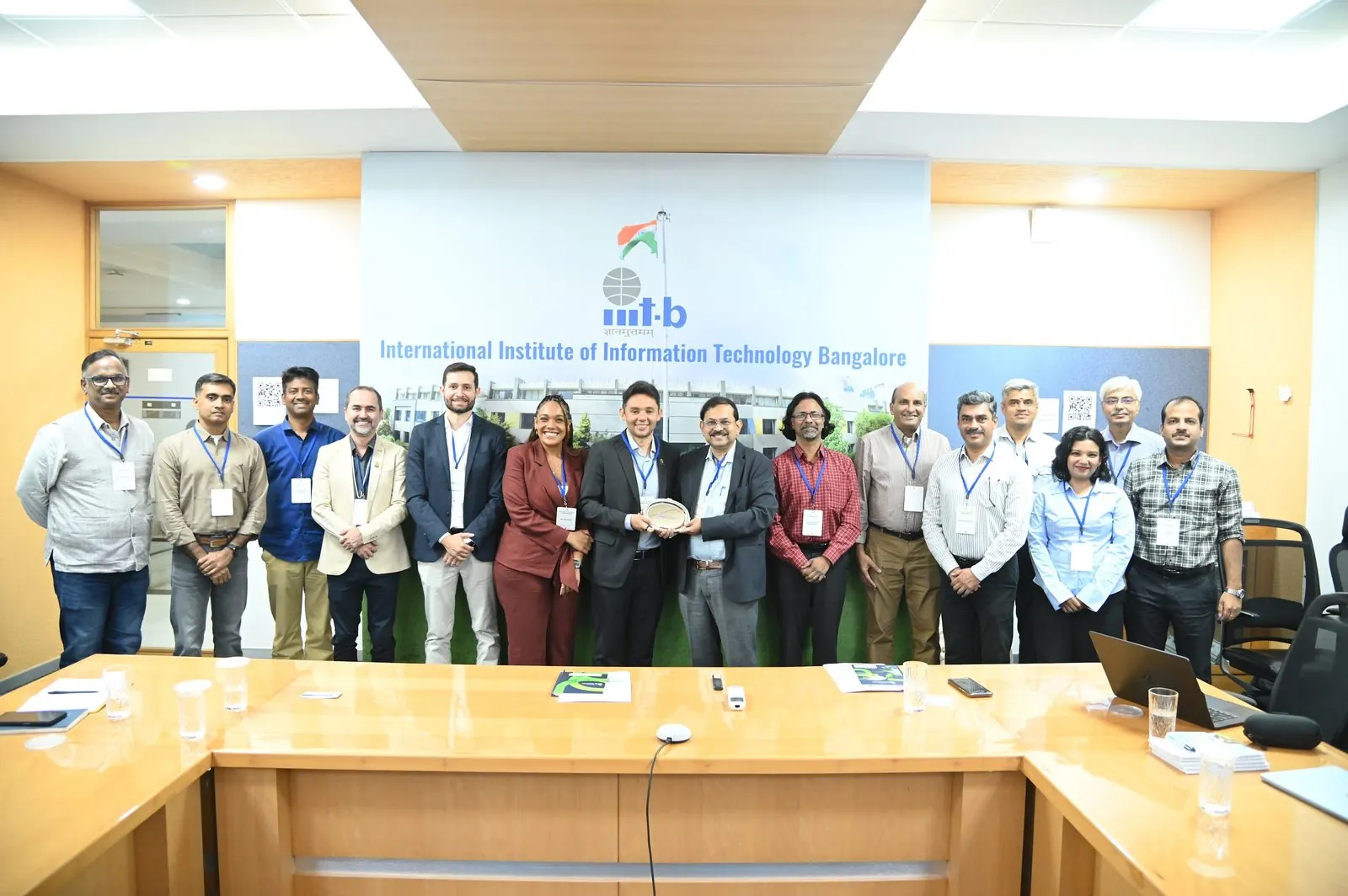
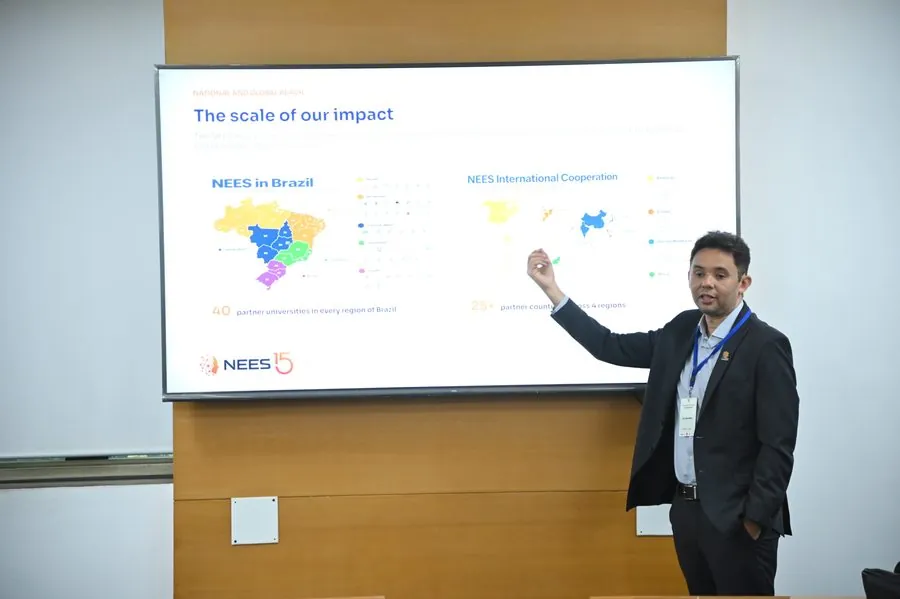
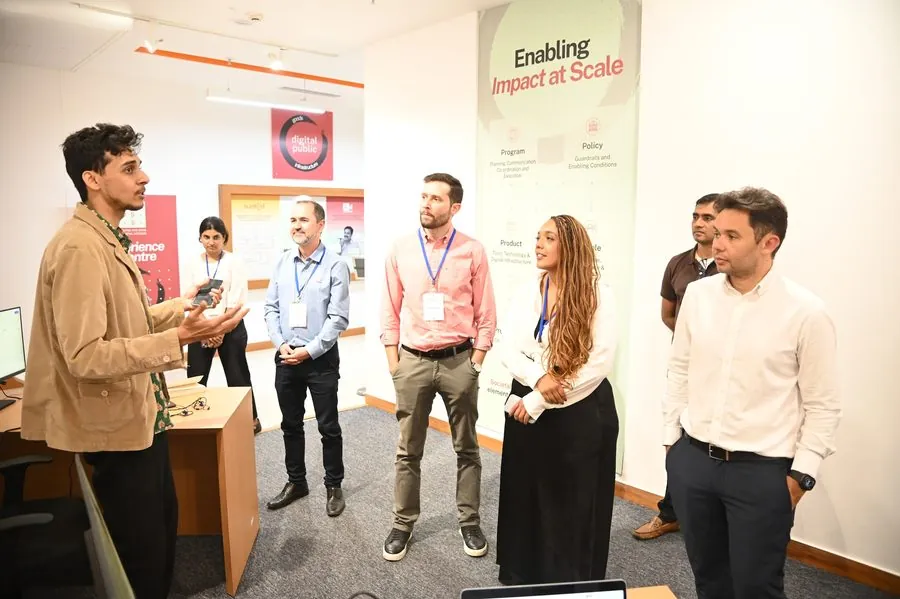
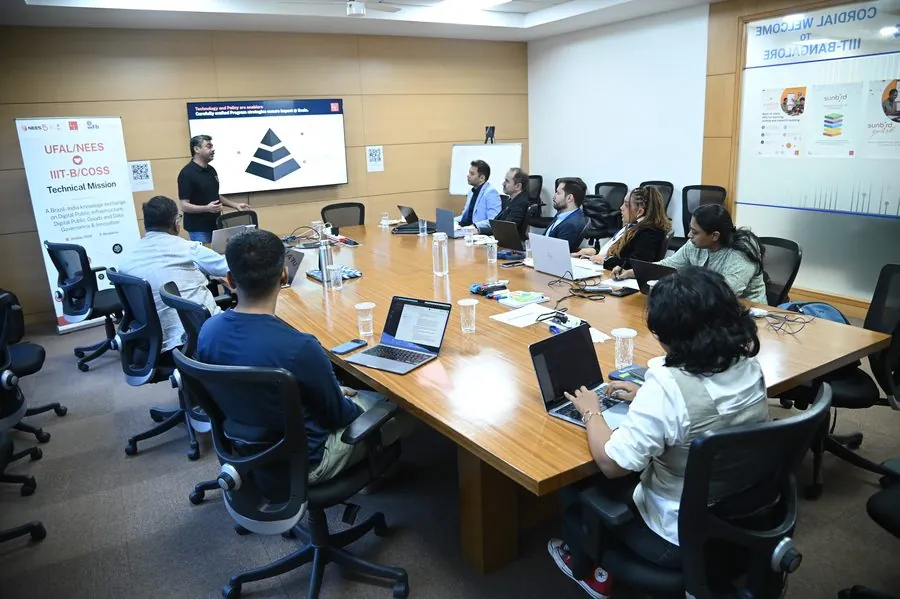
12–16 Oct 2026 · Bengaluru
The NEES/UFAL technical mission to IIIT-B and COSS deepened discussions on Sunbird, verifiable credentials, APIs and data governance. The exchange shapes new research questions and the building of the DPI Lab agenda.
Read the institutional record07 · Open knowledge
The maturity of an infrastructure depends on governance, capabilities and continuity. Explore questions that guide research and responsible adoption.
Clear roles, stakeholder participation and rules for data use should go hand in hand with technical choices.
Starting point: map stakeholders, responsibilities and accountability mechanisms.
Open standards, data quality, personal data minimization and protection by design support trust.
Starting point: document schemas, interfaces and security and privacy requirements.
Institutional capabilities, funding, monitoring and maintenance sustain service continuity.
Starting point: define who is responsible for operations, indicators and a continuity plan.
Documentation, clear licences and maintenance communities favour reuse. Open knowledge and digital public goods can contribute to global public goods.
Starting point: record lessons learned, adaptation conditions and the licence of each component.
W3C · 2025
W3C open data model for issuers, holders and verifiers.
Access the referenceGovStack
Specifications and implementation guides from the GovStack initiative.
Access the referenceDPGA
Openness, documentation, privacy and good-practice requirements from the DPGA.
Access the reference08 · Build with us
Universities, governments, research centres and international organizations can propose research, exchanges, training and experimentation.